THE NFL’S MOST EXPOSED QUARTERBACK JUST GOT PROTECTION—NOW FANTASY SHOULD PAY ATTENTION
By DraftUncut
LAB REPORTS
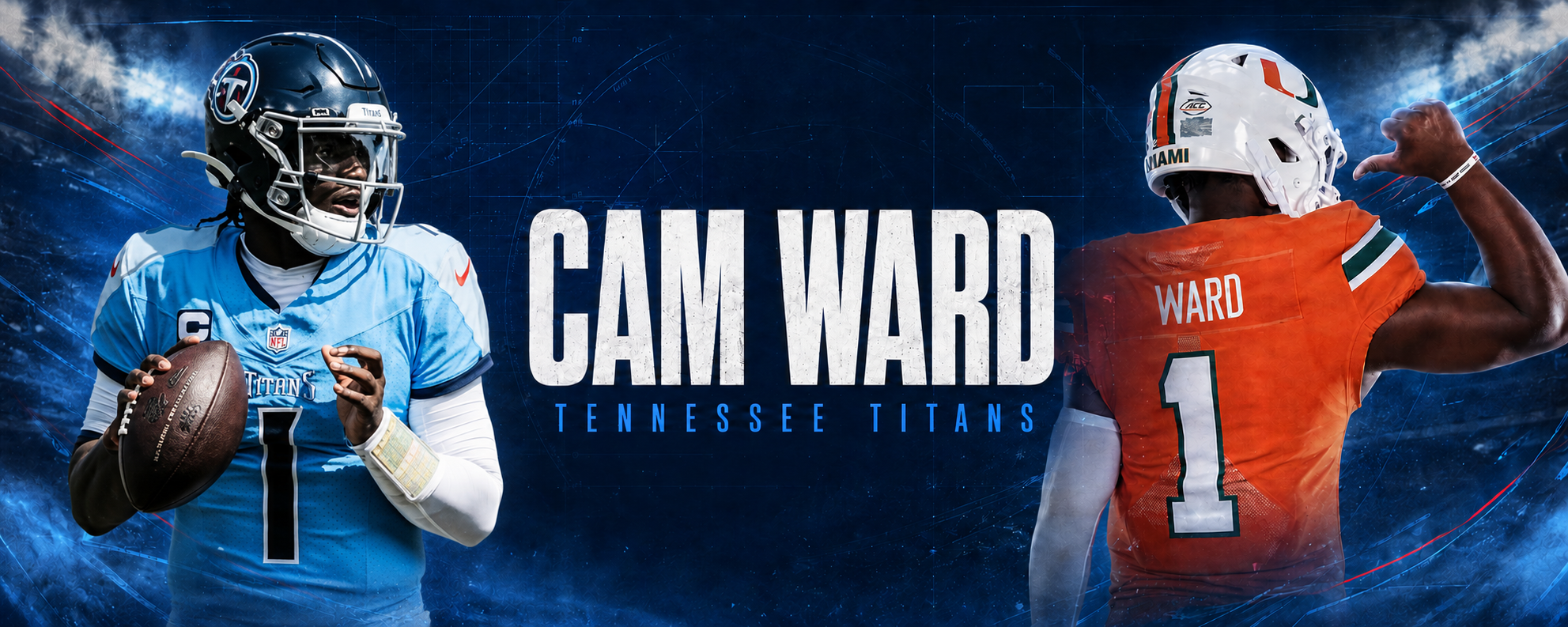
Cam Ward survived his rookie season. In Year 2, the Titans are finally giving him the infrastructure to produce.
Cam Ward didn’t simply struggle through a difficult rookie season. He operated inside an offense that consistently left its most important player exposed.
Ward was sacked a league-high 55 times in 2025. He still started all 17 games, threw for 3,169 yards and finished with 15 touchdowns against only seven interceptions. Those numbers weren’t spectacular, but they were produced inside one of the NFL’s least favorable environments for a young quarterback.
The film showed more than the box score.
Ward’s arm elasticity, off-platform accuracy and willingness to attack never disappeared. The problem was that too many snaps became survival exercises before the route concept could fully develop. Tennessee asked a rookie quarterback to create offense without consistently providing protection, separation or schematic answers.
That environment has changed.
BRIAN DABOLL CHANGES THE EQUATION
The most important addition may not be a player.
Brian Daboll is now coordinating the Titans’ offense, and his system should give Ward more defined answers before and immediately after the snap. Ward has already discussed learning to see the game through the eyes of both his offensive line and receivers, allowing him to anticipate pressure, process coverages and release the football faster.
That matters because better protection does not exclusively come from five offensive linemen winning isolated matchups.
Protection also comes from spacing, route timing, pre-snap identification, play-action and giving the quarterback an accessible answer against pressure. Daboll’s responsibility is to reduce the number of snaps in which Ward feels obligated to become the entire offense.
Ward’s creativity should become a weapon again—not an emergency response.
THE OFFENSIVE LINE DOESN’T NEED TO BE ELITE
Tennessee’s projected offensive line includes Dan Moore Jr. at left tackle, Peter Skoronski at left guard and JC Latham at right tackle. Those three provide continuity at the most important spots, while Austin Schlottmann, Cordell Volson, rookie Fernando Carmona and others compete for the interior positions.
There are still questions at center and right guard. This should not be presented as a finished or elite unit.
But Ward doesn’t need a top-five offensive line to take a significant step forward. He needs the Titans to move from dysfunctional protection to league-average stability.
One additional second can transform this offense. It allows intermediate routes to develop, gives Ward time to manipulate safeties and creates more opportunities for the aggressive throws that made him the first overall selection.
Average protection may be enough to unlock above-average quarterback production.
TENNESSEE FINALLY GAVE HIM ANSWERS
The Titans didn’t only address the structure. They upgraded the people operating inside it.
Carnell Tate was selected fourth overall to become Ward’s long-term primary target. Tate produced 17.2 yards per reception with nine touchdowns during his final college season and enters the NFL as a polished route runner with body control, strong hands and legitimate downfield ability.
He gives Ward something Tennessee lacked last season: a receiver capable of winning as the first read without requiring the quarterback to extend every play.
Wan’Dale Robinson adds another essential element. He arrives after recording 92 receptions for 1,014 yards and four touchdowns in 2025. His quick separation from the slot gives Ward a reliable answer against pressure and creates efficient completions that can keep the offense ahead of schedule.
Calvin Ridley remains the veteran vertical threat. A healthier Ridley would prevent defenses from concentrating exclusively on Tate and provide Ward with another receiver capable of threatening coverage outside the numbers.
Elic Ayomanor and Chimere Dike now move into more appropriate complementary roles instead of being forced to carry a passing game before they were ready.
This is no longer an offense asking Ward to manufacture every explosive play himself.
THE BACKFIELD HELPS MORE THAN THE BOX SCORE SUGGESTS
Tony Pollard remains the leading option in the backfield, with Tyjae Spears providing receiving ability and explosiveness in space. Rookie Nick Singleton adds another vertical element with the speed to punish defenses that become too aggressive attacking Ward.
A credible running game changes the geometry of the offense.
It slows down edge rushers, makes play-action more effective and creates simpler coverage structures for a young quarterback. Pollard and Spears can also function as immediate outlets when protection breaks down, turning negative plays into manageable gains.
Singleton’s presence gives Tennessee a potential home-run threat capable of converting a well-blocked run into six points. That forces linebackers and safeties to respect the backfield instead of constantly attacking Ward.
The Titans do not need one running back to dominate touches. They need the entire room to make defenses hesitate.
THE FANTASY CASE
Ward’s rookie numbers established the floor. His new environment creates the ceiling.
The improved receiving corps should produce more yards after the catch, more sustained drives and substantially more red-zone opportunities. Better protection should increase the number of explosive completions while reducing drive-killing sacks. Daboll’s system should also create easier throws without removing the improvisational ability that separates Ward from ordinary pocket passers.
There is risk. The offensive line remains unproven, Tate is still a rookie and Ward must improve his accuracy and decision-making when pressure arrives.
But those concerns are already reflected in his acquisition cost.
Fantasy managers are not being asked to draft Ward as a locked-in QB1. They are being offered a second-year quarterback with first-overall-pick talent, improved coaching, upgraded weapons and one of the clearest environmental-growth paths at the position.
That is exactly the profile worth targeting after the established stars are gone.
Cam Ward entered the NFL as its most exposed young quarterback. One year later, Tennessee has surrounded him with a legitimate WR1 prospect, an elite-volume slot target, a deeper backfield and a system designed to help him play faster.
He survived Year 1.
If the Titans provide even average protection in Year 2, Cam Ward may not simply improve—he could become one of Fantasy’s most reliable weekly point generators.
He is one of the best QB2 selections available in 2026, with a realistic path to finishing as considerably more than that.
https://x.com/draftuncut
Explore The Lab.


