Money Mike is Cashing In
LAB REPORTS
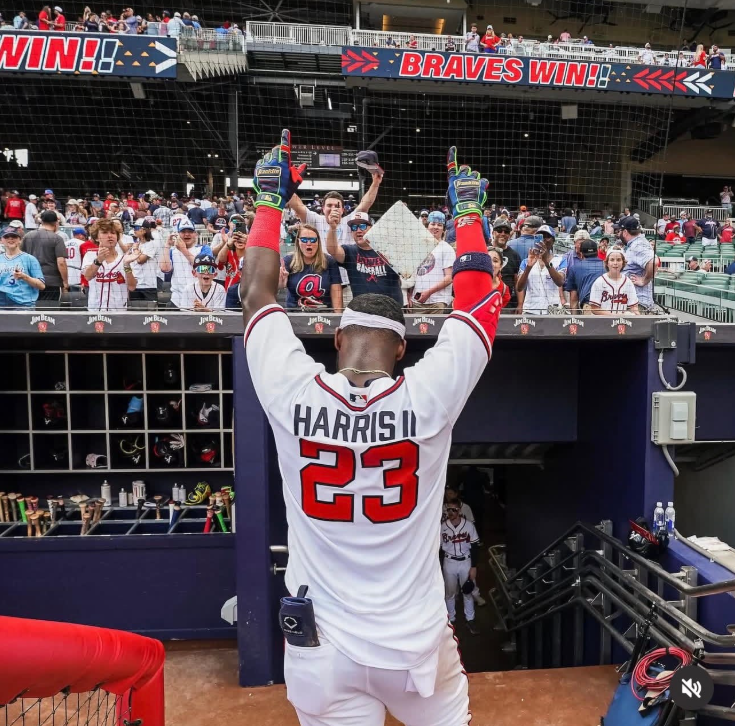
Michael Harris II is breaking out in a big way this season.
The evolution of Michael Harris II has been something to behold this baseball season. The Braves centerfielder began his career as a premier prospect for the organization. The need was so great for his raw skills that Atlanta called him up to the big league club straight from Double-A as a 21-year-old. Surely, Braves fans remember when he first came up. His defense was highly touted as to the level of former Brave, Jason Hayward, and the offense was given high praise in Just Baseball’s scouting report. Harris II’s hard-hitting ability with the potential for more power was noted.
What followed was an amazing Rookie year that culminated in Harris II taking the NL ROY award in 2022. An almost 20 HR/20 SB after playing only 3/4ths of the year, and a share of first-year success with SP Spencer Strider (a career story for another time). As many know, with a strong rookie year comes even greater expectations. If you think about it long enough, you can come to this realization: We expect so much from young athletes. So much so, when they begin to have a slump, a minor setback, or seem to show signs of dimming their stardom, we tend to write them off.
Now to be fair, Harris II did seem to struggle pretty regularly. After a still solid 2023 season (.293/.331/.477), his 2024 season was marred by injury, a low walk rate, and the lowest isolated raw power (ISO captures a player’s ability to hit for extra bases per at-bat) for his career (.155). Harris II found himself at the bottom of the lineup most games as well, hitting anywhere between 6th and 9th. Fast forward to 2025, and it was more of the same, but even worse. His walk rate (2.5%), slugging (.409), and hard-hit rate (43.3%) were all the lowest of his career. Through 93 games, Harris II was hitting an anemic .210 BA, .268 OBP, and a .317 SLG.
Then, in July of 2025 something changed. We began to see those same flashes of promise that “MHII” showed us in his rookie season. A midseason mechanical adjustment was made, and it might of just been the launching pad that the now 25-year-old needed to kickstart his promising career. From July until the end of the season, he salvaged what would have been an otherwise horrendous year, hitting to the tune of a .299 batting average with 14 homers, 42 RBIs, 33 runs scored and an .845 OPS. He was hitting the ball harder and with more authority. What was this change that caused this meteoric rise? It was all in the stance.
Making the Adjustment
MLB Network's Mark DeRosa breaks down the midseason adjustments that Michael Harris II made last season that have continued into 2026.
Michael Harris II changed his batting stance and part of his approach at the plate. After the change, MLB Network recapped the mechanical batting adjustment that Michael had made in the middle of the 2025 season. There was a noticeable difference in his batting stance, which saw the centerfielder return to the stance that brought him success when he first came up to the Show. His hands came back up, his front foot and timing looked back to its old self, and the back side of his swing was sound and balanced through the baseball.
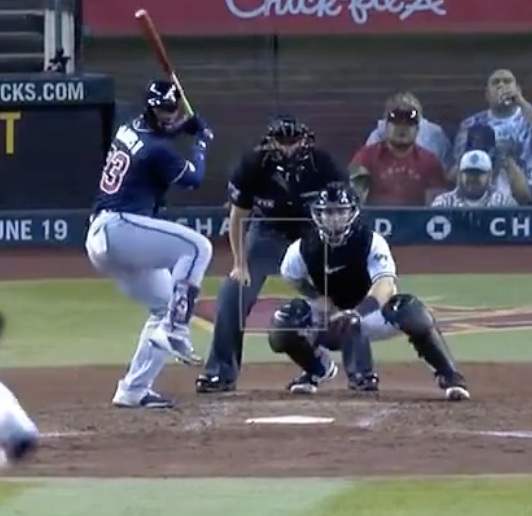
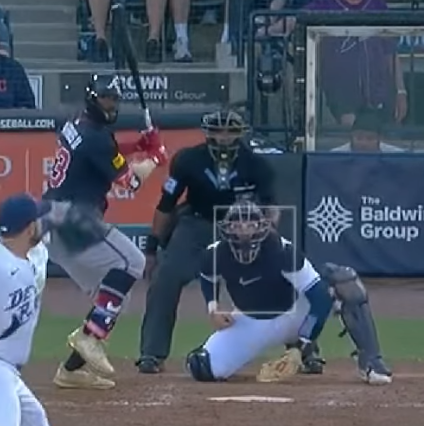
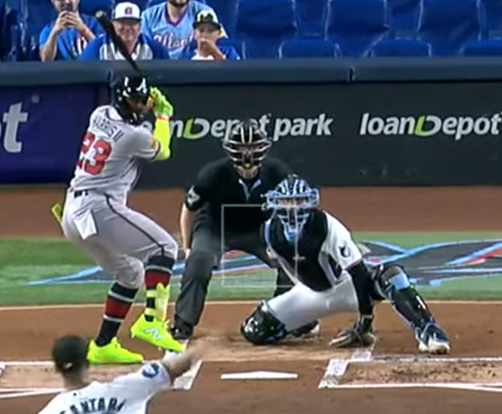
Left: Harris II in 2022; Center: Harris II in 2025; Right: Harris II in 2026.
Here are three different images that show Harris II at the same point in his swing in order to make a few observations for how he has shown this new stance and approach at the plate. One of the first things you will notice is that his load and hand placements in 2022 and 2026 are almost identical. This is what Mark DeRosa had shown in the video above. Harris II reverted back to what worked for him at the start of his MLB career. Part of it is in the way the front half and back half of his body are in his stance. He picks up his lead foot in '22 and '26 to time the pitch and over exaggerates the movement towards the plate, so when the foot comes down, he stays inside the baseball. His weight appears more evenly distributed when he shifts his weight from his back foot forward.
The power in his swing is much more effective with the hand placement. In his timing mechanism with the front foot, he's not pulling it to RF as much with the over exaggerated movement in place as if it serves as a guardrail and reminder for himself to stay inside the ball. And, even though he starts open in his stance, he does not open up on his swing to render himself incapable of covering the outside part of the plate. Both aspects of his swing are contributing to the quality of contact he is getting as well as the conviction he has in the pitches he swings at.
In the '25 version of Harris II his hands go up and then back before they ever start coming through the baseball. There is significantly more movement in his swing, which means even less margin for error with his hands to have a direct path to the ball. This year and in '22, the hands are already up and go back slightly on the load, while his front shoulder stays closed and inside the baseball when he swings.
With this adjustment in stance, we have seen just how much Harris II has evolved. Even still and strangely enough, the plate discipline for him has not changed. He’s chasing more pitches than he ever has at 45.4% (1st percentile among qualified hitters per Baseball Savant), and he still struggles with the slider (.231 BA). His strikeout percentage (20.5%) is around league average (roughly 22%), and the walk rate (4.3%) are both right in line with his career averages (20.6 K%, 4.1 BB%). What has changed is his plate coverage, and the types of pitches he is swinging at. Michael is covering more of the outside part of the plate than he did last year and in 2024. He is swinging less when he is pitched inside, and has completely committed to covering where pitchers are trying to pitch him most. They have wanted to throw Michael the slider about as often as they did his rookie season (12.4% in 2026; 13.7% in 2022), but it seems he is making sure to cover it and hitting it with power (.273 ISO).
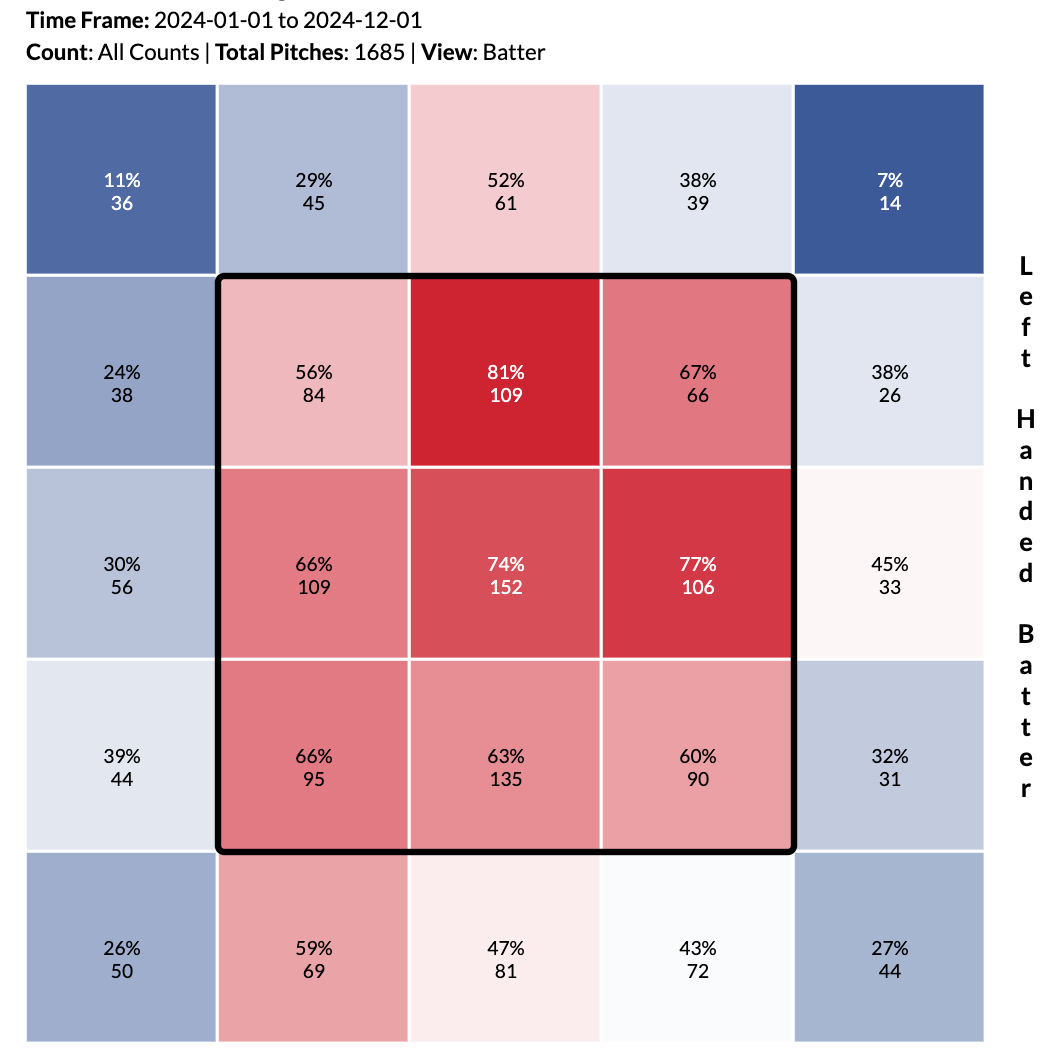
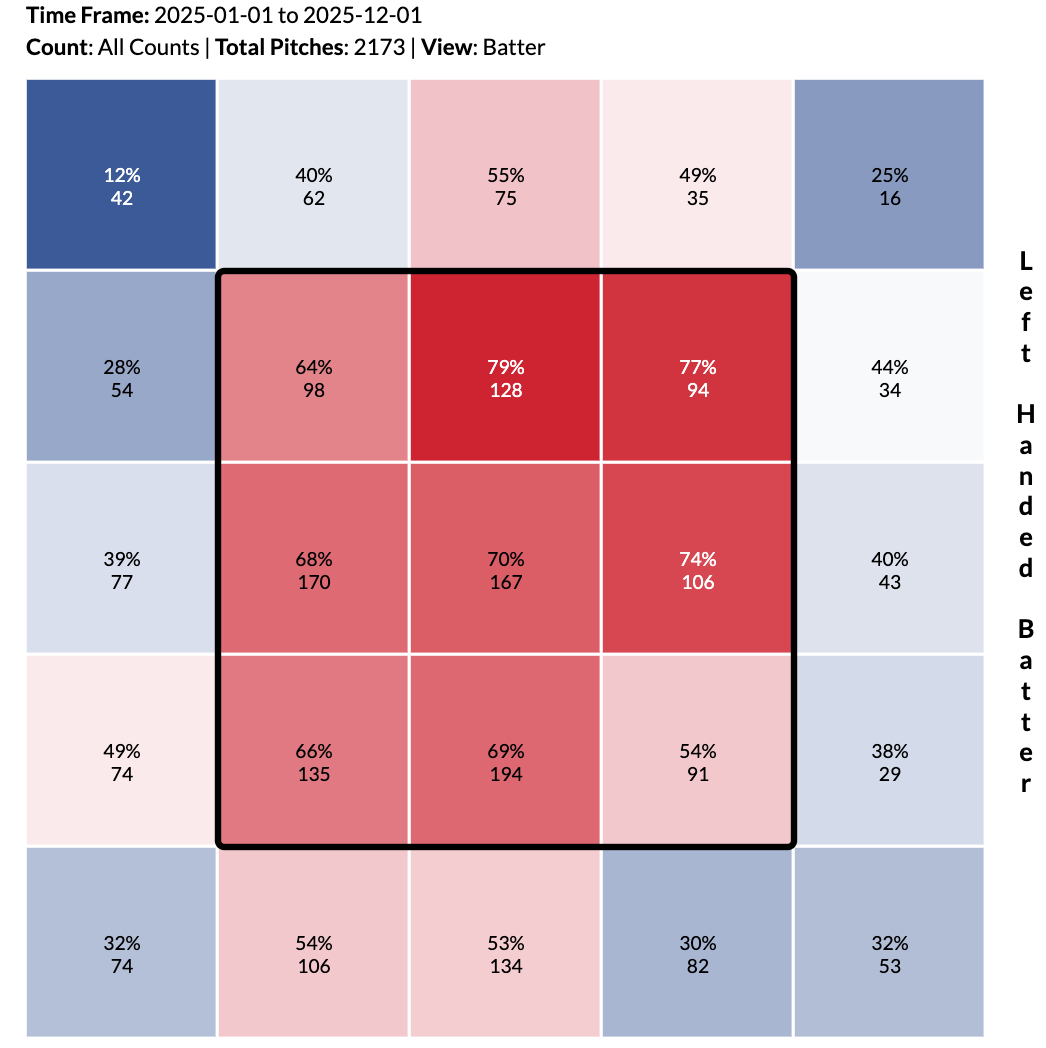
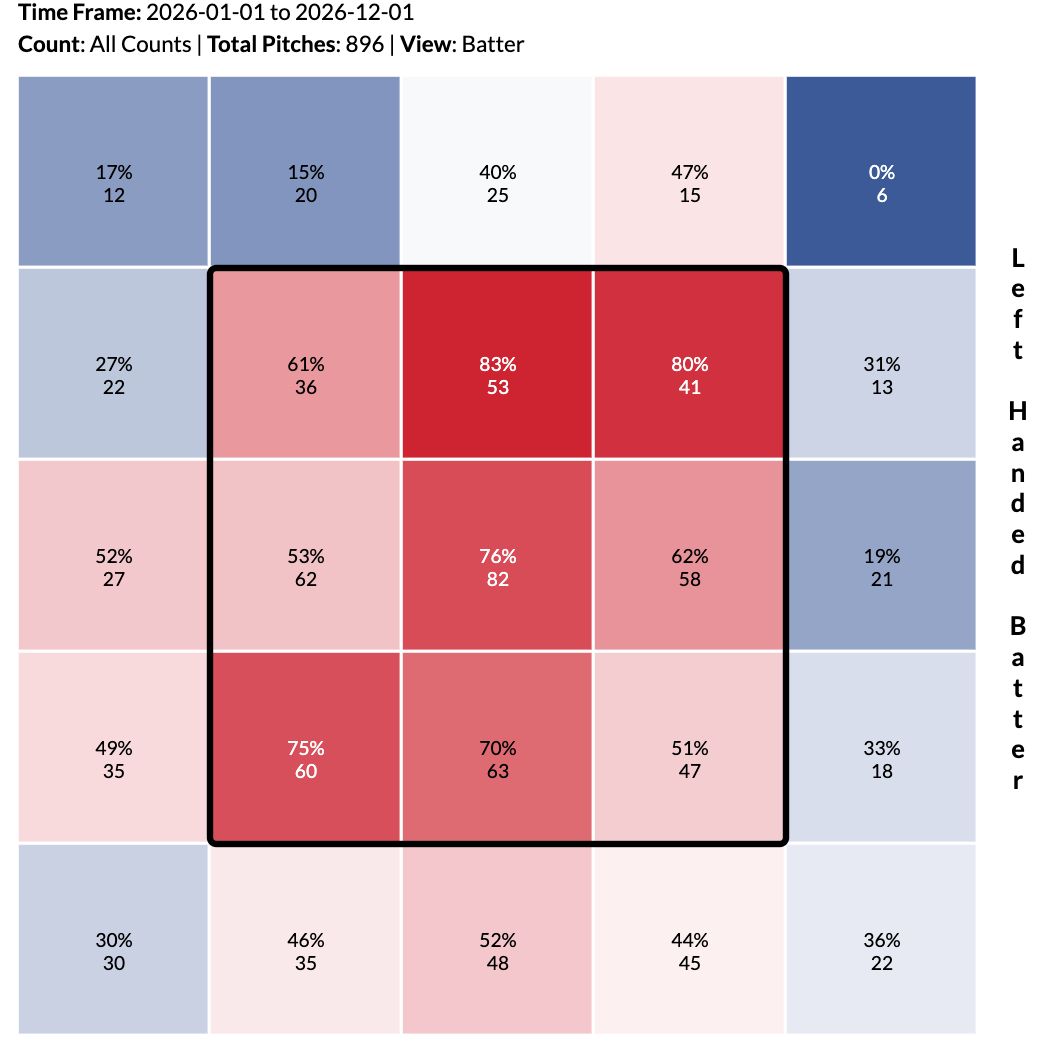
Michael Harris II Swing% vs All Pitchers 2024 to 2026 left to right. (Courtesy of FanGraphs- fangraphs.com)
Above are the heat maps for Harris II's swing percentage versus all pitchers and the locations he is swinging in the most. On the left in 2024, we see that the heat map is not as widespread compared to 2025 (center) and up to this point in the 2026 season (right). There are some noticeably large differences that are a direct result to the changes he has made in his swing, stance, and approach. In '24, there are barely any red zones outside of the strike zone off the outer part of the plate. Both low and away, and the middle of the plate are covered in the zone and outside the zone by Harris II.
One last noticeable change is in his approach and his improvement in hitting the changeup. A run value of 3 and a .361 BA are a career best for Michael. This cannot be underestimated because it may illustrate bets for us that his new approach, although aggressive, is paying dividends. Paradoxically, Harris II is both aggressive and patient at the same time. Aggressive because of the chase in his game, but patient in that he is recognizing the changeup, adjusting mid swing, and staying on the pitch to drive it. Simply put, by making contact with a pitch that is designed to keep an aggressive hitter like Mike off balance, it further proves he is seeing the ball better than he ever has. Maybe this article could have just said that, but where would all the fun be in that?
Do the Numbers Tell the Story? Is it Sustainable?
If you are just starting to understand the ever-changing baseball data world that is Sabermetrics, then do not be overwhelmed by these numbers. They can help us tell if this new offensive approach is truly working and if it is sustainable for Harris II. Here is a quick recap with some added numbers and expected stats:
- Harris is swinging at more pitches outside of the zone, but he’s also making more contact on pitches in the zone than ever before in his career (89.2%).
- He is hitting it on the ground less and hitting it in the air more (GB% of 41.9 is the lowest in his career, and a FB% of 39.2 is the highest of his career).
- His hard-hit rate this season is so far the highest of his career (39.9% compared to 32.0% in '25).
- He’s hitting the ball to center better this season than in any prior year (45.8%), which means he is on time and on target.
- Batting run value of 9 at the heart of the plate is the highest of Michael’s career. Meaning, he is taking advantage of a pitcher’s mistakes.
- The expected stats are elite and justify the breakout (See the Percentile Rankings below from Baseball Savant).
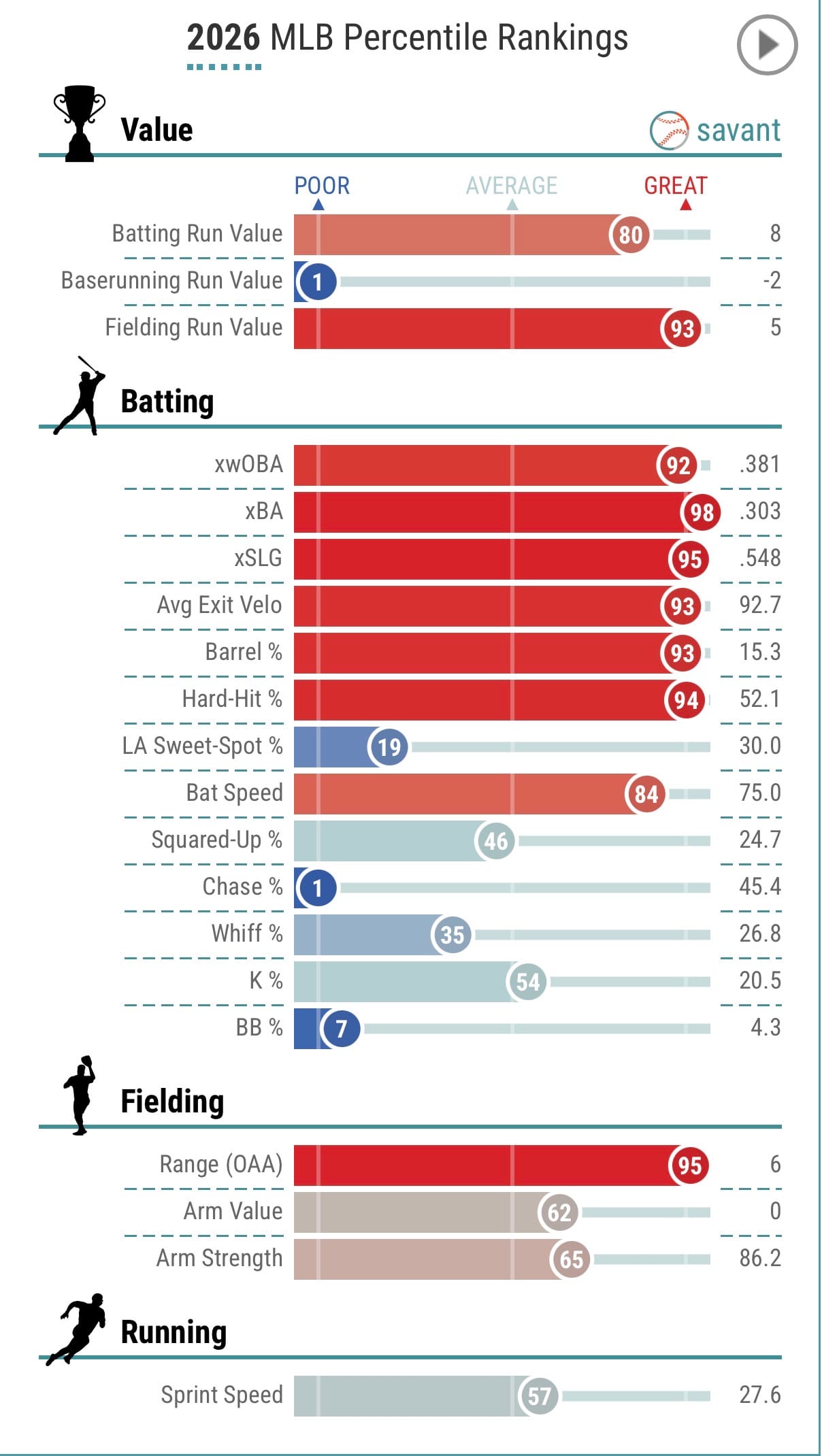
Verdict: Buy Into The Breakout.
As I said earlier, Michael Harris II is seeing the ball well again after crushing it his rookie year. The chase and whiff in his bat will make him prone to the slump at times, but who isn’t? His K-rate and walk-rate have not changed, but what matters is he is making contact and he’s making contact hard and powerfully (career high 92.7 avg. exit velocity). His eye at the plate has improved significantly as his bat is following the pitch better now than it ever has (15.3 barrel %). He knows where and how pitchers are going to pitch to him, and he’s trying to make them pay. What that means is no more bottom of the lineup for MHII. Sometimes, this type of adjustment is all it takes. A player like Mike returning to what works, and trusting what got them into the league in the first place. Fantasy managers and Braves fans alike can rejoice because “Money Mike” has arrived.
Explore The Lab.