
The WR Litmus Test: Separating Dynasty WR Breakouts From Fool’s Gold | Part 2
Part 2 The WR Litmus Test
LAB REPORTS
Every offseason, the dynasty community finds itself divided on a handful of wide receivers. Some players are viewed as the next breakout stars, while others are labeled as players riding unsustainable production or hype.
The goal of this series is simple: separate legitimate dynasty breakouts from fool’s gold. Using advanced metrics, I’ll evaluate each receiver’s opportunity, efficiency, and situation before giving a final dynasty verdict.
These players were selected because they either exploded onto the scene, flashed a high-end ceiling, or are entering a situation where increased opportunity could drastically change their dynasty value.
The question we’re trying to answer: Are these players the next breakout stars, or are dynasty managers buying into a mirage?
Metrics
For each receiver, I will evaluate three key areas:
Opportunity: Are they earning enough volume to support fantasy production?
Efficiency: Are they maximizing their opportunities and showing signs of elite talent?
Situation: Does their team environment create a realistic path to future production?
Within these categories, I will analyze the following metrics:
- First Read Target Share
- Route Participation
- Air Yards
- Air Yards per game
- Target Separation
- Explosive Plays
- Yards Per Target
- Fantasy Points per Route Run
- PFF Grade
To provide additional context, I will also grade several key metrics using the following thresholds:
Target Share
- Elite=27+%
- WR1= 22-26%
- Secondary Option= 18-21%
- Average= 14-17%
- Below Average= under 13%
Targets Per Route Run (TPRR)
- Elite= 0.25+
- Average= 0.20-0.24
- Below Average= under 0.19
Yards Per Route Run (YPRR)
- Elite=2.0+
- High End Starter=1.5-1.99
- Average= 1.10- 1.49
- Below Average: under 1.09
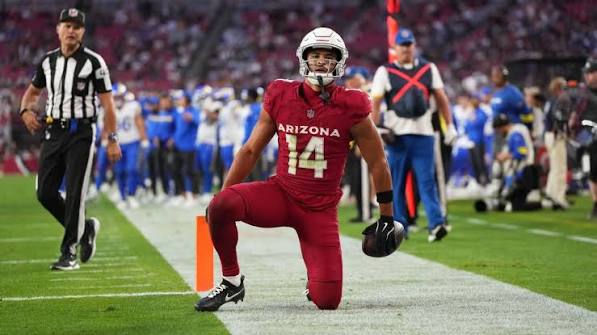
Michael Wilson
- KTC Rank: WR41
- Age: 26
- Draft Capital: Round 3, 94th Overall
- Team Vacated Targets at WR: 1
There are plenty of dynasty managers buying into Michael Wilson after his breakout 2025 season.
At first glance, it's easy to see why. He finished as one of fantasy football's biggest surprises and now enters Year 4 with a new offensive play caller that many believe could unlock another level.
But was Wilson's breakout sustainable, or was it simply the product of injuries, inflated passing volume, and favorable circumstances?
Let's run him through the WR Litmus Test.
Opportunity
- Target Share: 20.4% (Secondary Option)
- TPRR: 0.20 (Average)
- Air Yards: 1502 (10th)
- Air yards per game: 88.4
- First Read Target Share: 29.7% (23rd)
- Route Participation: 85.1%
On the surface, Michael Wilson's opportunity profile looks much better than many people realize. His 1,502 air yards ranked 10th among receivers, and his 85.1% Route Participation shows he was consistently on the field and running routes.
However, context matters. A large portion of Wilson's production came in an Arizona offense that was forced into heavy passing volume due to injuries and negative game scripts. The Cardinals ranked near the bottom of the league in rushing efficiency, which created more opportunities through the air than we should expect moving forward.
His 29.7% First Read Target Share is an interesting metric. On paper, ranking 23rd is encouraging and suggests Wilson was frequently one of the quarterback's initial reads. However, this number requires context. Marvin Harrison Jr. missed significant time during the stretch where Wilson produced his best games, and Trey McBride has established himself as the primary focal points of this offense.
Ultimately, Wilson's Target Share of 20.4% and Targets Per Route Run of 0.20 tell the story of a strong complementary receiver rather than a true alpha target earner. Even with his massive second-half production spike, Wilson still finished with metrics more aligned with a secondary option than a player capable of consistently commanding elite fantasy volume.
Efficiency
- YPRR:1.67 (High End Starter)
- YPT: 8.0 (42nd)
- FPPRR: 0.37 (45th)
- Target Separation: 1.19 (83rd)
- Explosive Plays: 14 (19th)
- PFF Grade: 76.4 (26th)
Unlike his opportunity profile, the efficiency metrics leave me with far more concerns than optimism. Wilson wasn't an inefficient player, but he also didn't consistently perform like a receiver capable of driving fantasy production on his own.
His 1.67 Yards Per Route Run places him much closer to an average starting receiver than the elite tier. Likewise, his 8.0 Yards Per Target (42nd) and 0.37 Fantasy Points Per Route Run (45th) both fall in the middle of the pack, suggesting his production was solid but far from exceptional.
The biggest concern is Wilson's ability to create on his own. He ranked just 83rd in Target Separation at 1.19 yards, indicating he struggled to consistently generate space against defenders. While he did finish 19th in Explosive Plays and earned a respectable 76.4 PFF receiving grade (26th), those positives aren't enough to outweigh the fact that his overall efficiency profile looks much more like a quality complementary receiver than an ascending fantasy star.
Overall, the efficiency metrics reinforce what we saw in the opportunity section. Wilson appears to be a solid NFL receiver, but nothing in his underlying profile suggests he possesses the elite efficiency that typically precedes sustainable fantasy breakouts.
Situation
The biggest question I have surrounding Michael Wilson isn't whether he's a good player—it's whether the circumstances that fueled his breakout are repeatable.
The most obvious example is his production with and without Marvin Harrison Jr. on the field.
With Marvin Harrison Jr. Healthy (10 Games)
- Team Pass Attempts/Game: 35.6
- 5.77 Fantasy Points Per Game
- 2.5 Receptions Per Game
- 26.6 Receiving Yards Per Game
- 0.1 TDs Per Game
17-Game Pace
- 43 Receptions
- 452 Receiving Yards
- 2 Touchdowns
Without Marvin Harrison Jr. (7 Games)
- Team Pass Attempts/Game: 41.3
- 23.27 Fantasy Points Per Game
- 7.6 Receptions Per Game
- 105.6 Receiving Yards Per Game
- 0.86 TDs Per Game
17-Game Pace
- 129 Receptions
- 1,795 Receiving Yards
- 15 Touchdowns
The splits are impossible to ignore. Wilson wasn't just slightly more productive without Harrison—he became an entirely different fantasy asset. At the same time, Arizona's pass attempts jumped by nearly six per game, creating significantly more volume for everyone involved.
Some will argue Wilson didn't breakout as a result of Marv being injured. I don't completely buy that. In Week 13, the only game Harrison played over 50% of the offensive snaps during Wilson's late-season surge, Wilson managed just 6.6 fantasy points. It was also his only game below 13 fantasy points from Week 11 through the end of the season. That's far too significant for me to dismiss as coincidence.
Adding to my concerns for Wilson is the arrival of new offensive coordinator Mike LaFleur. LaFleur comes from the Shanahan coaching tree, spending time with Kyle Shanahan before serving as the Jets' offensive coordinator and later working under Sean McVay with the Rams. His offenses emphasize zone running, play-action passing, heavy pre-snap motion, and creating efficient throws rather than relying on high-volume dropback passing.
This offseason, Wilson told ESPN that Harrison would fill the Davante Adams role while he would play the Puka Nacua role in LaFleur's offense. Unsurprisingly, that quote has generated a lot of excitement in dynasty circles.
I think everyone needs to take a step back.
The roles may be similar, but roles don't always create production—players do. Comparing Michael Wilson stepping into the "Puka role" to what Puka Nacua has accomplished ignores the enormous difference in talent and proven production between the two players. Simply occupying the same alignment in the offense doesn't guarantee the same fantasy results.
I'm also expecting Arizona's offensive philosophy to look much different this season. Last year, the Cardinals were decimated by injuries at running back and finished 31st in the NFL in rushing yards per game. They didn't have a single running back eclipse 92 carries all season.
After selecting Jermiyah Love with the third overall pick, it's hard to imagine that remaining the case. A healthier backfield combined with LaFleur's offensive background should naturally lead to a greater emphasis on the running game and play-action passing. Fewer dropbacks means fewer opportunities for a receiver who already projects as the third option behind Trey McBride and Marvin Harrison Jr.
When I put everything together, I believe Wilson's 2025 breakout came in nearly a perfect storm of circumstances. Injuries to the receiving corps, an unusually pass-heavy offense, and a temporary spike in target volume all combined to produce career-best numbers. Heading into 2026, I expect Arizona to be healthier, more balanced offensively, and far less reliant on Wilson than they were during his breakout stretch.
What Needs to Happen? Range of Outcomes
For Michael Wilson to become a true dynasty breakout, something has to fundamentally change.
The biggest factor is volume. With Marvin Harrison Jr. and Trey McBride healthy, it is difficult to project enough targets for Wilson to consistently produce as a fantasy starter. His production last season showed just how much his role expanded when Harrison was unavailable, but replicating that level of opportunity will be difficult in a fully healthy offense.
The other path would be Arizona significantly outperforming expectations offensively. If the Cardinals become one of the league's better or more efficient passing offenses, Wilson could still produce strong fantasy numbers despite entering the season as the third option in the offense.
Personally, I don't see either outcome as the most likely scenario. I expect Arizona to attempt to lean more on the running game under Mike LaFleur while funneling targets through Marvin Harrison Jr. and Trey McBride. That leaves Wilson competing for consistent volume rather than having it naturally available.
Best-Case Scenario
Arizona's offense exceeds expectations, Mike LaFleur successfully unlocks Wilson in the "Puka" role, and the Cardinals become a highly efficient passing offense.
Wilson establishes himself as the clear No. 2 option in the passing game behind Trey McBride, or benefits from missed time by one of those two players. In that scenario, Wilson has enough volume to push for another WR2 fantasy season and significantly increase his dynasty value.
Worst-Case Scenario
The Cardinals become a run-first offense under Mike LaFleur, Marvin Harrison Jr. stays healthy, Trey McBride continues to dominate the middle of the field, and Wilson settles into a complementary role as the third option in the passing game.
His target share falls back into the mid-to-high teens, making him a boom-or-bust flex option with limited dynasty value growth.
Most Likely Scenario
I think Wilson lands much closer to the worst-case scenario than the best-case scenario.
He's a solid NFL receiver who should continue playing meaningful snaps, but I don't expect enough volume for him to consistently produce as a fantasy starter. With a healthier supporting cast and what I expect to be a more balanced offensive approach, Wilson profiles as a complementary piece rather than a player taking another step forward.
WR Litmus Test Results
Opportunity: 🟡 INCOMPLETE CONTEXT
Wilson's opportunity profile looks stronger at first glance than it does under further examination. His air yards, route participation, and first-read target share suggest a receiver playing a meaningful role, but his overall target share and TPRR are more aligned with a complementary receiver than a true target earner. The biggest question is whether last season's increased opportunity was sustainable or largely a result of Marvin Harrison Jr.'s absence and Arizona's pass-heavy environment.
Efficiency: 🟡 UNCERTAINTY
Wilson showed he is a capable NFL receiver, but the underlying efficiency metrics do not point toward an ascending fantasy star. His YPRR, FPPRR, and YPT all ranked closer to the middle of the league, while his lack of separation raises questions about his ability to consistently create production on his own. The explosive plays and strong PFF grade are encouraging, but not enough to outweigh the overall efficiency profile.
Situation: 🔴 FAIL
The biggest concern with Wilson is the path to volume. Marvin Harrison Jr. and Trey McBride are established focal points of the offense, Arizona invested heavily into improving the running game, and Mike LaFleur's offensive philosophy could lead to fewer passing opportunities. Wilson's ceiling is heavily dependent on the Cardinals exceeding expectations offensively or an injury opening up additional targets.
Dynasty Verdict: SELL
The verdict for me is simple. Michael Wilson is a player I am actively selling.
Wilson is a talented NFL receiver who should continue to have a role, but I don't believe his 2025 breakout is sustainable. The splits with Marvin Harrison Jr. are the biggest reason why. Wilson was a completely different fantasy asset when Harrison missed time, but that also came with a massive increase in passing volume and opportunity that will be difficult to replicate.
Moving forward, I expect Arizona to lean more heavily into the running game under Mike LaFleur while funneling targets through Marvin Harrison Jr. and Trey McBride. Both the Shanahan and McVay offensive systems have consistently created opportunities for tight ends, and I don't expect that to change with one of the best young tight ends in football already established as a focal point of the offense.
If you currently roster Wilson, I would look to capitalize on the value created by last season's breakout before the market adjusts. I would rather pivot to receivers with a clearer path to long-term volume and target dominance.
Contender Pivot: Terry McLaurin
Any Build Pivot: Ricky Pearsall, Quentin Johnston
Rebuild Pivot: Denzel Boston, Antonio Williams, Germie Bernard
Wilson is exactly the type of player this series was designed to identify: a player who had a breakout season, but whose opportunity, efficiency, and situation raise major questions about whether that production can continue.
Explore The Lab.


Recent Lab Articles.
Read more
Bullpen Notes
9/12

Starts, Sits, and Splits: Week 1
Welcome to The Delta Duo’s FIRST EVER Starts, Sits, and Splits for Week 1. Each week we'll identify two Starts at each position, two Sits at each position, and a Split: one player where the two halves of the Duo are split in our decision. We’ll
Weekly Edge Report
FTO’S FBB Weekly Edge Report: September 14 – September 20
Bullpen Stock Watch
9/12