
The New Normal: Rome Odunze, a Broken Foot, The Burden of Burden, and Potentially...The Cheapest Alpha in Fantasy
A (roughly) WR29 price tag on a guy who was the fantasy WR3 a month into last season. Whether you buy that discount comes down to TWO things: An injury holding up, and how Chicago uses Luther Burden
LAB REPORTS
A (roughly) WR29 price tag on a guy who was the fantasy WR3 a month into last season. Whether you buy that discount comes down to TWO things: An injury holding up, and how Chicago uses Luther Burden
Through four weeks of the 2025 season, Rome Odunze was the fantasy WR3. Five touchdowns, Caleb Williams' clear favorite target, and out loud he was talking about chasing Randy Moss' single-season touchdown record. Through seven games he had 473 yards and five scores, a pace that projects to roughly 1,150 yards and 12 touchdowns over a full year. And then a bone in his foot broke, and the season quietly came apart.
He never had surgery. He healed with what he calls a "new normal," a callus that reshaped the structure of his foot, and he compared it to an ACL that is never quite the same again. He faded down the stretch, missed the final five regular-season games, came back for the playoffs, and did not look like the same player.
So here is the setup heading into 2026: DJ Moore is gone. Odunze is the nominal WR1 on an ascending offense in Ben Johnson's second year, and he is being drafted as the WR28. That is a wide gap between role and price. This piece is about whether you should close it, and the honest answer is that it hinges almost entirely on a player we can only project the impact of...Luther Burden.
This runs in four parts.
Part One: the alpha we forgot, and why this specific offense concentrates targets on one man. Part Two: the room, roughly 150 vacated targets, and the real story of who Luther Burden actually threatens. Part Three: the foot, the comps, and what the medicine says about a non-surgical break that heals into a different shape. Part Four: the bet and whether you take it.
Part One: The Alpha We Forgot
Odunze's full 2025 line looks pedestrian: 44 catches, 661 yards, six touchdowns on a team-leading 90 targets in 12 games. But the average buries the story, because the healthy version and the hurt version were two different players. Table 1 splits them.
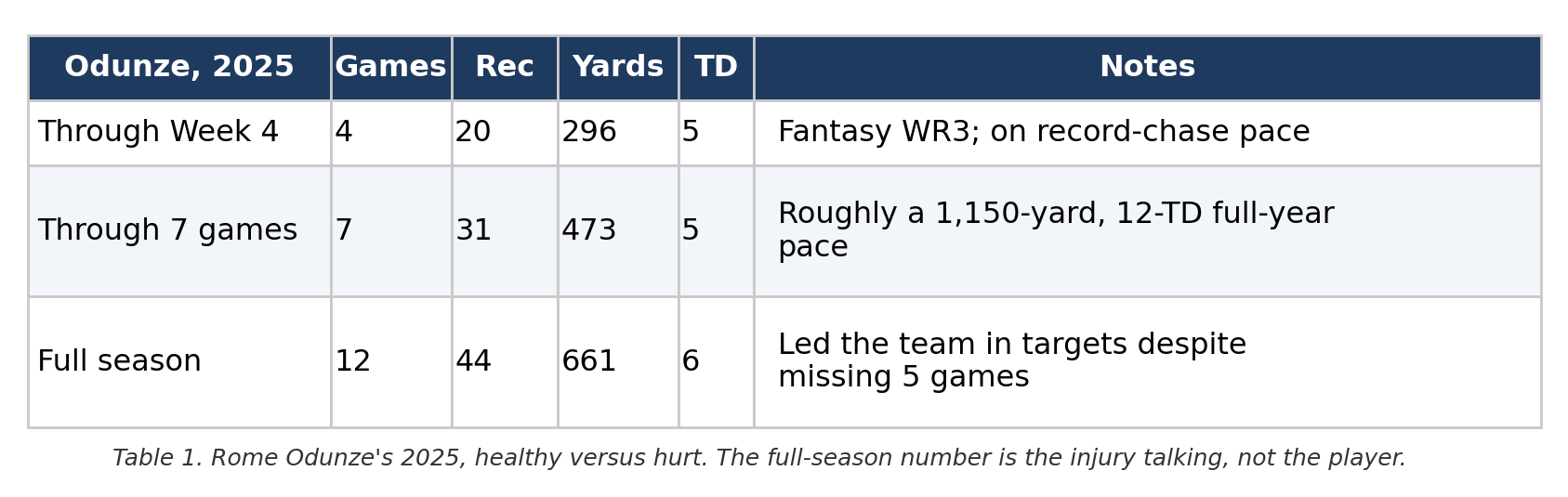
The right baseline for projecting 2026 is not the full-season line. It is the healthy stretch, because that is the player when his foot worked.
Now layer in the scheme. Ben Johnson's Detroit offense did not spread the ball evenly. It funneled elite volume to one alpha: Amon-Ra St. Brown carried a 29.0% team target share as the hub of that passing game. This matters because the biggest risk with a three-mouth young pass-catching room is that nobody eats enough to matter. Johnson's history says the opposite. His offenses pick an alpha and feed him.
The tell for who that alpha is in Chicago is already on tape. Even playing on a fractured foot, Odunze led the Bears in target rate in Johnson's first year. That is the single most useful fact in this whole study: the target hierarchy already sorted itself, and it sorted to Odunze, while he was hurt. However, things change, and that change could very well hurt the alpha that Odunze was last year.
Part Two: The Room
Start with supply, because the room got a lot emptier. Table 2 lays out the 2025 target distribution and who is no longer in the building.
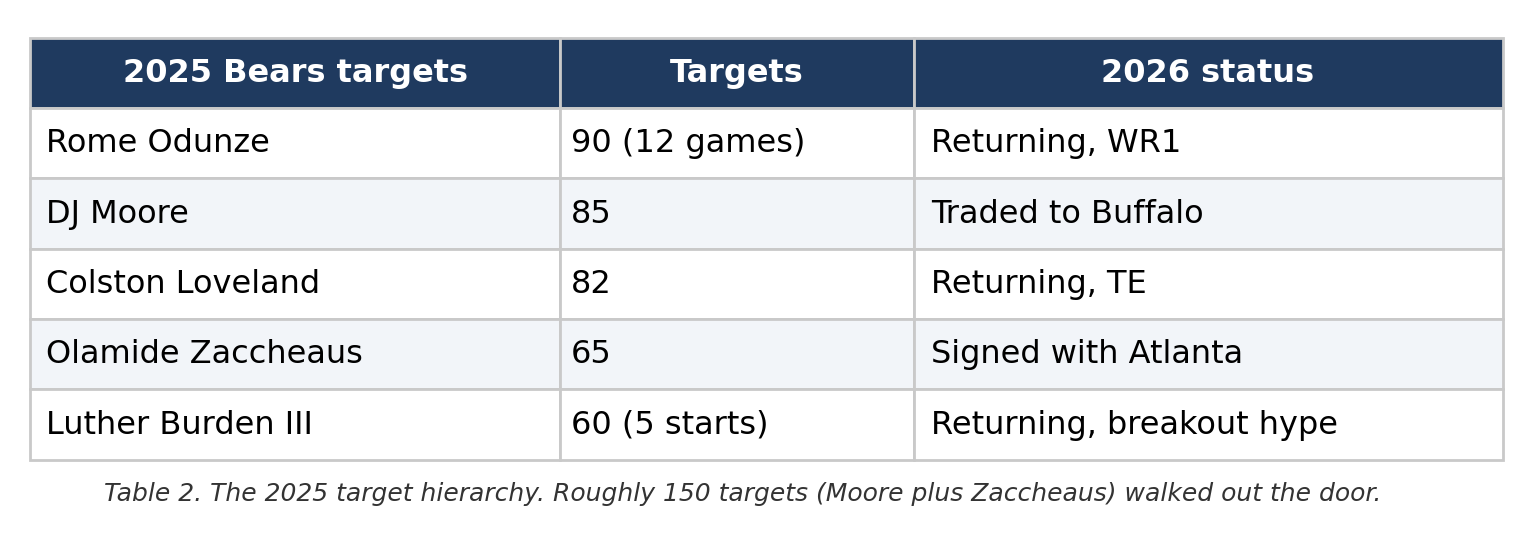
That is the first thing everyone gets wrong. This is not a fixed pie that Odunze, Burden, and Loveland fight over. Around 150 targets just vacated. All three can rise at the same time. Burden's Year 2 leap does not have to come out of Odunze's plate, because there is a giant empty plate sitting in the middle of the table.
The second thing that needs to be examined is who Burden actually collides with. The instinct is Odunze, because they are both young wideouts. But they do not play in the same place, at least historically. Last year Burden's rookie work came from the slot and the short interior, an underneath catch-and-run role: his average depth of target was 7.67 yards. Odunze is the opposite, a perimeter field-stretcher whose average depth of target was 14.5. When Burden eats, he eats from the middle of the field, the same ground the tight end works. When Odunze eats, it is outside and downfield. So Burden's rise presses on Colston Loveland's territory far more than it presses on Odunze's. However, this is assuming Burden's role stays the same.
Now the natural worry about Burden's role: slot receivers don't always stay put, so if Burden climbs, does he climb into Odunze's lane? Here the average landscape is reassuring. Only about 30% of all NFL pass attempts even go to the slot, and by FTN's charting just 15 of 81 qualified receivers were majority-slot in 2023. Slot receivers are a minority of the league, and a slot receiver who is also his team's No. 1 is rarer still. Classically, the slot guy is not the WR1.
Slot rookies also tend to stay slot rookies. We can't put a clean percentage on it, since alignment is a charting stat the public play-by-play can't see, but the named picture is consistent. Josh Downs has worked the slot at an 84% clip across his first two seasons, and Christian Kirk at 80%, both staying inside and staying complementary pieces. The default for a receiver who ate from the slot is that he keeps eating from the slot. For Odunze, that is the bullish base case: a slot-anchored Burden is a Loveland problem, not a Rome problem.
Here is the concern, and it has merit because of exactly what Chicago's head coach has been saying out loud. A few slot receivers do break the pattern, not by leaving the slot but by becoming the alpha inside it. Amon-Ra St. Brown is the cleanest example: a 58.8% slot man who still became a first-team All-Pro and the whole center of his offense. Jaxon Smith-Njigba is another, a 49.5% slot rookie who grew into a team-leading role the next year. It is rare. It also happens to be the specific outcome Ben Johnson is openly rooting for. Johnson coached St. Brown in Detroit. He calls the Bears' plays himself. He was in the building to draft Burden and not Odunze. And he has spent the offseason comparing Burden to St. Brown by name. The statistical fingerprint is already there: Burden's 7.67 aDOT is an exact match for St. Brown's under Johnson. If that comp comes true, Burden doesn't have to line up wide to hurt Odunze. He becomes a target hog from the slot, and a receiver commanding a St. Brown share, 100-plus catches and 1,200-plus yards in Johnson's offense, pulls the ball away from everyone, perimeter included. That is the version of Burden that dims Odunze's ceiling, and most likely, dims it singificantly.
But a comp is an example, not a verdict, and this is where Odunze's case holds. Two things keep him alive even in that scenario. First, the slot-alpha leap is the outlier, not the expectation; the base case is still a slot-anchored Burden eating mostly into the interior. Second, and it matters more: Odunze is nothing like the complementary receiver who usually rounds out a slot alpha's offense. Unlike Jameson Williams, the deep threat guy overshadowed by slot alpha St. Brown, Odunze is a 6-foot-3, 210-pound X who wins on contested catches, catch radius, and the red zone, the exact areas a slot receiver cannot own. And he has been an alpha himself, 92 catches for 1,677 yards and 14 touchdowns in his final college season, and the fantasy WR3 through the first four weeks of 2025 before the foot broke. A great Burden does not delete what Odunze is. It just means Odunze has to reclaim a role he has already shown he can hold.
| Jameson Williams | Rome Odunze | |
|---|---|---|
| Build | Lean speed, ~6'1", sub-185 | Big-bodied X, 6'3", 210+ |
| Primary win | Vertical speed, separation on deep overs | Contested catch, catch radius, red zone, plus downfield |
| Route tree | Historically vertical/limited | Fuller true-X tree |
| Pedigree | 12th pick, lost rookie year, 3-year project | 9th pick, drafted to be a WR1 |
| College role | Never the featured alpha | The alpha: 92-1,677-14 in 2023 |
| TD source | Bomb-dependent (50-yard strikes) | Size-based, repeatable red-zone looks |
So Part Two lands on Odunze, where it should. Burden's breakout is far likelier to come out of Loveland's share than Odunze's, because the two don't share the field. The one route where Burden genuinely threatens Odunze is the rare one, a St. Brown-style alpha rising out of the slot, and the Bears are plainly chasing it, it isn't yet a guarantee. However, any Odunze believer needs to watch it closely.
Part Three: The Foot
This is the part that is entirely independent or role, scheme, and the players around him. It opens with a caveat we cannot get around: we do not know which bone Odunze broke. Every report says "stress fracture in the foot" and stops there. That single unknown governs the entire prognosis, because a foot is not one thing.
If the break is in the fifth metatarsal, the Jones-fracture zone, or the navicular, then the non-surgical route he chose is the high-risk path. That bone has notoriously poor blood supply and heals slowly, which is precisely why the famous receiver comps all had surgery. If it is a more common metatarsal-shaft stress fracture, non-surgical management is standard and the outlook is fine. We are projecting in the dark on the most important variable, and anyone who tells you otherwise is guessing.
What we do know: he declined surgery specifically to avoid having rods or hardware placed in the foot. The healing produced a bone callus that shifted the structure, which is what he means by "new normal," and he has said it is never fully back to normal the way an ACL never is. He was still referencing lingering effects at OTAs in June.
A study of Jones-fracture recovery in NFL players found that those who returned in under 10 weeks after surgery had a statistically significant greater drop in post-injury performance, and were more likely to need a second surgery. Rushing re-breaks. Patience heals. Even Julio Jones, a Jones-fracture success story, later snapped the surgical screw in that foot and needed a revision, which is a reminder that this bone carries recurrence risk even when it is done right.
Now the good news, and it is real, and it is the strongest single point in Odunze's favor. The variable that wrecked Dez was time, and time is the one thing Odunze got. He was not rushed back mid-season and asked to cut on a half-healed bone. He got a full offseason. On the timeline axis, the axis that actually predicts bad outcomes, he sits on the Julio side, not the Dez side. That is not spin. That is the finding.
The open question is the structural residue, the shape change itself. Here the mechanism is real but the comp shelf is nearly empty. Biomechanically, altered load distribution across the foot is itself a documented risk factor for metatarsal stress fractures, and the cleanest mechanistic work shows that a geometric change to a metatarsal displaces where force lands and can transfer stress to adjacent bones and joints, with the bone remodeling to the new load state over time. So "the structure changed and now the load redistributes" is a legitimate, literature-backed worry, not something we invented.
But, and this is the honest part, there is no clean athlete comp for "healed with a residual callus and altered structure, here is how the next season went." That branch is comp-poor, because almost every serious NFL foot fracture gets surgically fixed, so nobody is tracking the non-surgical-residue population. The callus itself is normal healing and typically reshapes and smooths over time, which again favors a player with a full offseason behind him. We are left with a plausible mechanism and no population to test it against. We flag it as a risk. We do not price it.
Part Four: The Bet
Put everything together and we get a clearer picture.
The bull case. Healthy, this is a top-five fantasy receiver: WR3 through a month, on a 1,150-and-12 pace before the break. He flashed as the alpha in a scheme that funnels targets to one man, and he has the pedigree to keep and maintain it, entering that scheme's Year 2. Roughly 150 targets just vacated. His perimeter-leaning role keeps him out of the interior scrum that Burden and Loveland are fighting over. Even if Burden commands more targets and becomes a slot alpha outlier, like St. Brown, Odunze is no Jameson Williams, he's much better. The timeline risk that ruins foot-fracture returns is largely behind him. And he costs a fourth-round pick, WR29. That is the delta.
The bear case. He took the non-surgical route on a break whose bone we cannot confirm, and if it is the wrong bone, that route carries real re-fracture risk. His own framing, the ACL comparison and the "new normal," is not nothing. The literature says foot fractures that are not fully sound underperform and re-break. He faded badly after the injury and did not look right even in the playoffs. And if Ben Johnson turns Burden into the St. Brown-style slot alpha he is openly chasing, Odunze's share gets squeezed no matter how clean the perimeter stays and how good Odunze is.
Net: this is a legitimate, high-variance buy-low where the entire range of outcomes runs through a foot we cannot fully diagnose and a player/scheme we can't fully predict. The delta is real. The risk is real. Both things are true at once, and that is exactly why he is cheap.
In redraft or if you are buying in dynasty, pick and buy him as what he is: not a safe WR2, but a discounted swing at a genuine alpha, priced as if the healthy Odunze never existed and Burden's role is a guarantee.
However in dynasty, the most useful thing this study can tell you is that you do not have to decide today, and you probably should not. My gut says fade the injury and Burden risk. My heart says a healthy Odunze is a league-winner you will regret selling, or passing up in a draft at his current ADP. The tie-breaker is that the single most decision-relevant variable is being settled in front of us, cheaply and observably, over the next few weeks. Acting on gut or heart right now throws away information you are about to get for free. So wait, and let two switches make the call.
Switch one, the foot. OTAs and walk-throughs cannot stress a healed bone the way live cutting and press-release reps can. The tell is not whether he practices, it is whether he holds up to a real workload without landing back on the injury report. This one you cannot fully read until the games are live.
Switch two, how Chicago uses Burden. This is the switch you can read early. Watch two things about Burden, in order.
- If Burden is lining up mostly on the perimeter early, or equally in slot and outside, that is a definite sell. It means he is now in Odunze's own real estate, the target floor tightens, and the injury risk is no longer cushioned by a clean, uncontested role. You do not want to hold a foot question and a target question at the same time.
- If Burden stays in the slot, look one level deeper: is he commanding alpha-level targets from in there? A slot-anchored Burden who is one of several mouths is the good outcome. Hold Odunze with conviction, because the interior traffic competes with Loveland while Odunze owns the perimeter. But a slot Burden who is drawing a St. Brown-sized share, double-digit looks per game, is the rare outlier from Part Two, and it is the real threat. That is the version that caps Odunze even though Burden never leaves the slot.
Two honest caveats so you do not overreact to noise. One game is a small sample in a scheme that moves people around, so read the trend across camp and the first two or three weeks, not a single snap chart. And none of this erases Odunze; the vacated-target cushion and his own alpha pedigree are real, so the signal should move your conviction rather than trigger a same-day fire sale. But the direction is clear and it is watchable, which beats guessing in August.
If you own Odunze, hold him and wait to see what happens in the next month or two. If you want to buy him, do it now while other people are worried about the foot and Burden. If you want to sell him, either find someone that believes, or wait until you see how the two situations play out. If you see Burden gaining steam, don't wait.
Here is the entire bet in one sentence: wait to see whether Burden is one weapon among several or the whole offense before you decide what Odunze is.
We don't draft players. We draft deltas. This one is a bet, on a bone and on a role, and the tell is in how Chicago uses Luther Burden.
Sourcing and Honest Limits
In the spirit of every Delta Duo piece, here is what is measured, what is sourced, and what is inference.
Measured / directly reported: Odunze's and Burden's 2025 stat lines, target counts, and the Bears' 2025 target hierarchy (team and standard stat sources). Odunze's 14.5 and Burden's 7.67 average depth of target, and Burden's St. Brown-matching aDOT (PFF and SI/Tru Media). The slot landscape (roughly 30% of pass attempts to the slot; 15 of 81 qualified receivers majority-slot in 2023) and the charted slot rates for St. Brown, Smith-Njigba, Downs, and Kirk (FTN charting). Amon-Ra St. Brown's production under Ben Johnson (Lions/PFF). That Ben Johnson calls the Bears' plays and compared Burden to St. Brown (NFL.com, SI, and Bears beat reporting). Odunze's college line, 92-1,677-14 (SI).
Sourced, not computed by us: We did not compute a slot-to-perimeter transition rate. Our first attempt, a play-by-play proxy using aDOT, could not actually see alignment and was discarded rather than dressed up as a finding. So the "slot rookies stay slot" claim rests on named charted examples (Downs, Kirk stayed; St. Brown, Smith-Njigba grew inside), not a homegrown percentage. A true rate would require PFF or FTN alignment data matched across seasons, which is a worthwhile follow-up, not a claim we are making here.
Inference and honest unknowns: We do not know the specific bone Odunze fractured, and that is the largest caveat in the piece. For injury we considered Julio Jones' and Dez Bryant's injuries, which were surgically managed Jones fractures, a different treatment path than Odunze's, so they were considered for direction, but not as matches to Odunze's situation. The structural-change concern is mechanism-plausible and literature-backed, but comp-thin; we could not find a clean non-surgical-residue athlete comp, and we did not manufacture one. The Jones-fracture recovery finding on return timing comes from published NFL injury research. Treat Part Three as a well-informed reading of an incomplete medical picture, not a diagnosis.
Explore The Lab.


