
The Mismatch Erasers: The Defensive Schemes and Cornerbacks Built to Neutralize Elite Archetypes
Insight on offensive players from the defense's perspective
LAB REPORTS
In our last piece, we broke down the exact tape mechanics that make elite pass-catchers a nightmare to cover. We looked at the heavyweights who win with a massive box-out frame, and the micro-movers who leave defensive backs grasping at air through elite route technique.
But NFL defensive coordinators aren’t just sitting on their hands. For every offensive cheat code, a defensive counter exists.
If you want to master weekly fantasy matchups, project down weeks for elite stars, or find lock-down sports betting angles, you have to look at the defensive side of the ball. Here is the blueprint for how modern defenses erase elite pass-catching archetypes, and the specific players and schemes built to do it.
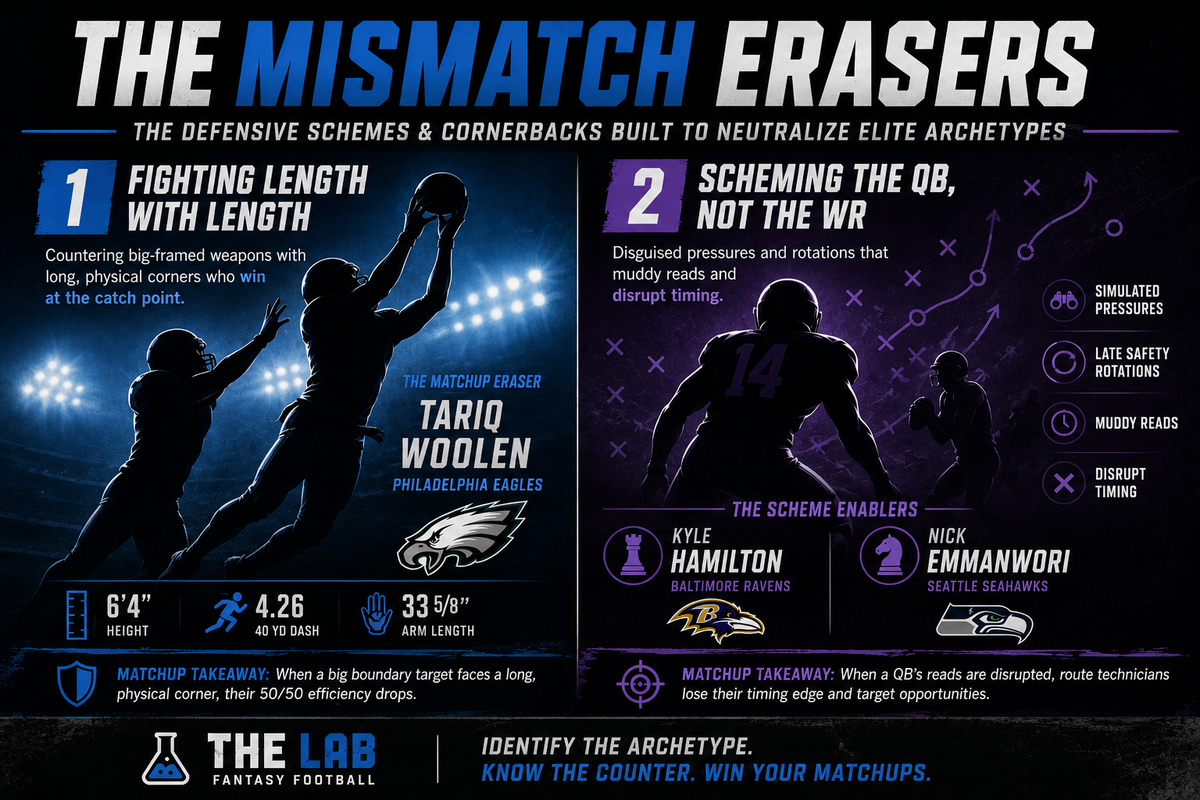
Neutralizing the Box-Out Specialists: Fighting Length with Length
The Offensive Threat: Big-framed wideouts who treat the boundary like a basketball court, using their catch radius to seal off defenders on back-shoulder throws and high-point fades.
The Defensive Answer: Press-mirror technique executed by hyper-athletic, long-limbed boundary cornerbacks.
To stop a receiver who wins via body shielding and frame density, a defense cannot afford to field a standard 5’10”, 190-pound corner. If the corner is giving up four inches of height and substantial arm length, they are fundamentally out of the play on a back-shoulder throw, no matter how tight their coverage is.
Instead, defenses counter these heavyweights by deploying rare, long-limbed cornerbacks who possess the recovery speed to play right in the receiver’s hip pocket and the reach to disrupt the catch point before the receiver can establish a box-out wall.
The Mismatch Eraser: Tariq “Riq” Woolen (Philadelphia Eagles)
Woolen is the apex version of this defensive counter, but track him in a new building now. He signed with Philadelphia in free agency this offseason, leaving Seattle for a one-year, $12 million deal under defensive coordinator Vic Fangio. Built at 6’4” with a blazing 4.26-second 40 and 33 5/8-inch arms, Woolen erases the typical physical advantages of big wideouts. When a quarterback tries to throw a deep back-shoulder fade to a big receiver, Woolen’s sheer length allows him to reach over or around the frame to break up the pass without having to commit pass interference. Worth noting for matchup purposes: Woolen actually allowed just 2.7 yards per target in man coverage last season, the best mark among corners with 20+ man-coverage targets, even as his ball production dipped in Seattle’s more disguise-heavy scheme. Fangio’s more straightforward, press-heavy approach in Philly could unlock the traits further.
Other Key Defenders to Track:
• Patrick Surtain II (Denver Broncos): 6’2”, 202 lbs. Plays with pristine technical discipline and physical frame density, meaning he rarely gets bullied or moved off his spot on the boundary.
• Sauce Gardner (Indianapolis Colts): Traded from the Jets to Indianapolis in November 2025 for two first-round picks and WR Adonai Mitchell, Gardner brings historic length and elite lateral mirroring that prevents big receivers from cleanly stacking him down the sideline. Notable connection for our purposes: Gardner and Alec Pierce (our Category 1 sleeper from the last piece) were Cincinnati teammates from 2019-2021 and are now both in the Colts building, meaning Pierce’s own practice reps against Gardner may end up being some of the best evaluation tape available on both players heading into camp.
The Weekly Matchup Takeaway:
When a big boundary target faces a defense that can line up a 6’2”+ corner with elite arm length, lower your expectations. Their baseline 50/50 target efficiency drops significantly.
Suffocating the Route Technicians: Scheming the Quarterback, Not the Receiver
The Offensive Threat: Low-center-of-gravity micro-movers who manipulate a defender’s leverage and instantly create separation out of their breaks on quick-rhythm concepts.
The Defensive Answer: Disguised split-safety pressure paths and simulated pressures that muddy the quarterback’s post-snap reads.
Trying to stop a premier route technician in 1-on-1 man coverage is a losing battle. If you give them a cushion, they take the easy underneath yards; if you press them, their sudden footwork wins early.
Because you cannot reliably defend the receiver with a single man, elite defensive minds, like Mike Macdonald in Seattle and now Jesse Minter in Baltimore, defend the quarterback instead.
Minter’s move to head coach doesn’t dilute his defensive fingerprints. It amplifies them. He built this exact disguise-and-simulated-pressure identity as a defensive assistant in Baltimore from 2017-2020, refined it running Michigan’s defense to a national title, and turned the Chargers into a top-5 unit in his two years as their coordinator. Now he owns the whole building. Expect him to stay hands-on with the defensive game plan and personnel usage even while carrying head-coaching duties, which means the scheme’s core identity (muddy the picture, make the QB hold the ball, force turnovers) should be the strongest version yet.
These schemes rely heavily on simulated pressures (showing a 6-man blitz pre-snap but dropping edge rushers out into passing lanes while blitzing a defensive back instead). By shifting the post-snap picture entirely, the defense forces the quarterback to hold the ball for an extra half-second to figure out where the safety help is coming from. That split-second delay destroys the tight timing required for sharp, rhythm-based route running.
The Chess Pieces: Kyle Hamilton (Baltimore Ravens) & Nick Emmanwori (Seattle Seahawks)
To run these high-disguise, structure-breaking schemes, coordinators need hyper-versatile, elite defensive backs who can rotate from the deep half down into the slot seamlessly.
• Kyle Hamilton: Now working under Minter as Ravens head coach, Hamilton remains a moving target. One snap he is lined up as a deep split-safety, the next he’s blitzing the B-gap, and the next he’s dropping out into the exact shallow-crosser lane a route technician is trying to break into. This isn’t just containment. It’s a defense designed to feed off the confusion it creates. When a route technician’s timing gets disrupted by disguise, that hesitation shows up as tipped passes, contested throws into a closing window, and turnovers. Hamilton is the player best positioned in the league to capitalize on exactly that, and the rest of Baltimore’s back end, Nate Wiggins on the boundary and Malaki Starks alongside Hamilton at safety, gives Minter multiple bodies who can rotate into those disguised looks and be the one who ends up with the ball in his hands.
• Nick Emmanwori: The Year 2 breakout candidate to know. Seattle’s 2025 second-rounder posted a perfect 10.0 Relative Athletic Score at the combine (6’3”, 220 lbs, 4.38 forty, 43-inch vertical) and immediately became a centerpiece of Mike Macdonald’s Super Bowl-winning defense as a rookie, finishing as runner-up for Defensive Rookie of the Year. He gives Macdonald the same size-speed chess piece that makes these disguised schemes go: someone who can walk down into the slot to match a technician one snap and rotate to a deep half the next.
A note on personnel movement: Derwin James remains one of the league’s most versatile defensive backs, but he stays with the Chargers, not Baltimore. Minter’s departure for the Ravens’ head coaching job leaves Los Angeles under new defensive leadership: Chris O’Leary, promoted from Western Michigan’s DC chair after previously coaching the Chargers’ safeties in 2024. O’Leary already has real history with the room, he coached James’s safety group directly two years ago and helped Elijah Molden to career highs that season, so this isn’t a scheme rebuild from scratch. Worth tracking how much O’Leary keeps Minter’s disguise-heavy identity intact versus putting his own stamp on it.
The Defensive Units to Watch:
• Seattle Seahawks (Mike Macdonald): Heavy usage of post-snap rotations and split-field pattern matching that keeps quarterbacks completely off-balance, now with Emmanwori entering Year 2 as a full-go chess piece.
• Baltimore Ravens (Jesse Minter): Minter’s promotion to head coach means his disguise-heavy defensive fingerprints now run through the entire building, not just the coordinator’s call sheet. A masterclass in obnoxious pre-snap communication and simulated pressures that take away quick-rhythm throws, and, with Hamilton and a talented back end executing it, a defense built to turn that disruption into actual takeaways rather than just clean coverage reps.
The Weekly Matchup Takeaway:
If your star route technician is facing a Macdonald-led Seattle defense or a Minter-run Baltimore unit, beware. The offense’s passing windows will be muddy, leading to slower processing times, disrupted rhythm, and lowered floor performances for high-volume slot targets. Against Baltimore specifically, that disruption doesn’t just cap the receiver’s ceiling. It raises real turnover risk for the quarterback throwing into it, with Hamilton and the Ravens’ secondary positioned to be the ones cashing in.
Who’s in the Crosshairs (and Who’s Exempt)
All this matters most on a per-matchup basis, and the sharpest cut is division play: whoever shares a division with these defenses sees them twice a year, guaranteed. Meanwhile, the receivers who share a locker room with these defenders never face them at all. That second group is easy to overlook and worth flagging up front.
Philadelphia Eagles (Woolen), NFC East
In the crosshairs twice a year: CeeDee Lamb and George Pickens (Cowboys), Malik Nabers (Giants), Terry McLaurin and Deebo Samuel (Commanders).
Exempt: DeVonta Smith. The Eagles traded A.J. Brown to the Patriots in June, so Smith is now Philadelphia’s top receiver and Woolen’s own teammate, meaning he never has to line up across from him. Worth noting for the same reason in reverse: Brown now plays in the AFC East, so despite being one of the league’s best true box-out receivers, he no longer sees Woolen at all.
Indianapolis Colts (Gardner), AFC South
In the crosshairs: Nico Collins (Texans), Brian Thomas Jr. (Jaguars), Calvin Ridley and rookie Carnell Tate (Titans).
Exempt: Alec Pierce, our Category 1 sleeper from the last piece. He and Gardner are Colts teammates now, so he’s fully insulated from the player we just flagged as one of the best length-on-length correctors in the league. That’s a real, if underrated, boost to his weekly floor.
Denver Broncos (Surtain), AFC West
In the crosshairs: Rashee Rice and Xavier Worthy (Chiefs), Tre Tucker (Raiders), Ladd McConkey (Chargers).
Exempt: Jaylen Waddle and Courtland Sutton. Denver just traded for Waddle this offseason, pairing him with Sutton in the same receiver room Surtain plays behind. Both are fully shielded from arguably the best boundary corner in the division.
Seattle Seahawks (Macdonald), NFC West
In the crosshairs: Puka Nacua (Rams), Mike Evans and Ricky Pearsall (49ers), Marvin Harrison Jr. (Cardinals).
Exempt: Jaxon Smith-Njigba. This is the case that started the conversation: JSN plays for the team running this defense, not against it, so he never has to solve the exact scheme this piece is describing. His own numbers should be read independent of how tough this unit is on everyone else in the division.
Baltimore Ravens (Minter/Hamilton), AFC North
In the crosshairs: Ja’Marr Chase and Tee Higgins (Bengals), DK Metcalf and Michael Pittman Jr. (Steelers), Jerry Jeudy and KC Concepcion (Browns).
Exempt: Zay Flowers. Baltimore’s own WR1 gets to watch the disguise-and-takeaway machine from the friendly side of the ball twice a year, while everyone else in the division has to solve it.
The Weekly Matchup Takeaway:
When you’re setting lineups or evaluating a receiver’s weekly floor, check the schedule before you check the box score. A receiver in the same division as one of these units is going to see it twice, no exceptions. A receiver on the same roster as one of these units never sees it at all, and that’s a real, ongoing tailwind that rarely gets priced into weekly rankings.
The Fantasy Application
When setting weekly lineups, don’t just look at “points allowed to wide receivers.” Dig deeper:
1. Identify the archetype of your fantasy starter.
2. Look at the opponent’s defensive personnel and scheme. Are they running heavy post-snap disguises? Do they have a corner who matches your boundary receiver’s length?
If the opponent has the specific physical or schematic eraser to counter your player’s best trait, that is your cue to look elsewhere for upside.
Explore The Lab.


Recent Lab Articles.
Read more
NFL defenses are messing with your fantasy roster.
The NFL passing game has been declining for five straight years. It's not a fluke or a bad run of quarterbacks; defenses have just changed the math. Understanding why tells you exactly which positions to attack in 2026 fantasy drafts.

Stop Making These Startup Draft Mistakes
Read this before your draft.
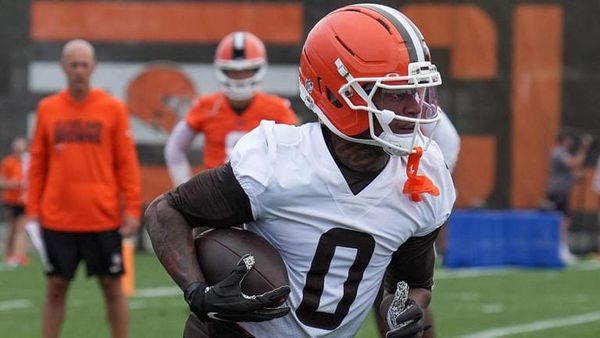
Deep Dive: Isaiah Bond
Does the Browns’ Speedy WR Have Real Dynasty Potential?
Bullpen Stock Watch
7/13