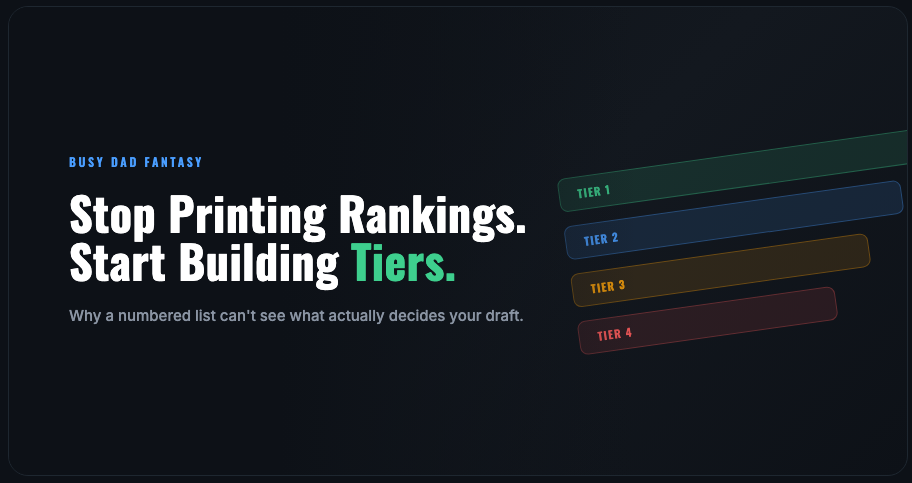
Stop Printing Out Rankings. Start Building Tiers.
Draft strategy matters
LAB REPORTS
We see it all the time. You're at your draft, having a few beers while you wait for everyone to show up, and then someone in your league pulls out the top 150 draft sheet they got from their favorite fantasy source. We've all done it. Rankings are fun, and we debate them every single year. But here's why I think we should all be leaning on a tier-based approach instead.
What Tier Based Drafting Actually Means
Tier based drafting means grouping players together based on similar value instead of looking at them through a traditional numbered rankings format. A single tier might have 4 or 5 running backs in it, and I'd genuinely be happy landing any one of them on my team. Instead of stressing over whether I have running back 14 or running back 17 correctly ordered, I just care about which group of players he falls into. If two guys are in the same tier, the order between them barely matters. What matters is knowing when a tier is about to run out, so you know when it's actually time to make your move.
Why Rankings Lie to You
Here's my problem with a straight numbered list. It pretends there's a real, meaningful difference between the player ranked 14 and the player ranked 17, when most of the time there isn't one. That gap on paper gets treated like a gap in actual value, and it isn't. I've watched people reach for a specific name at the top of a mini run just because the sheet in their hand said he was 3 spots higher than the guy sitting right below him, guys who are basically interchangeable. A ranking also freezes everything into one static number. It can't tell you a guy's coming off an injury, or that his target competition just changed, or that his situation is genuinely murkier than the guy one spot behind him. It just hands you an order and expects you to trust it blindly.
How I Actually Build My Tiers
You might be asking yourself, how do you actually build out your tiers? For me, this is where the insanity kicks in. I start by ranking players in a traditional 1 through 150 format, but I do this by position, not overall. Ranking by overall can actually limit you, because it's harder to see when a specific position is starting to dry up. If you're only looking at one long overall list, you might miss the moment where running backs are flying off the board, and you still have plenty of time on receivers. Doing it by position first lets me see that clearly, so I'm not reaching for a running back I could have gotten two rounds later just because I was staring at an overall list. From there, I look at their average ADP, which is much easier to work through in rounds 1 through 4 than later in the draft. Once I have that baseline, I start layering in the things a straight ranking can't tell you. Injury risk. Off the field issues. Opportunity and target share. That's when players start shifting into the same tier as guys ranked well above or below them on paper.
How Tiers Change Draft Day Decisions
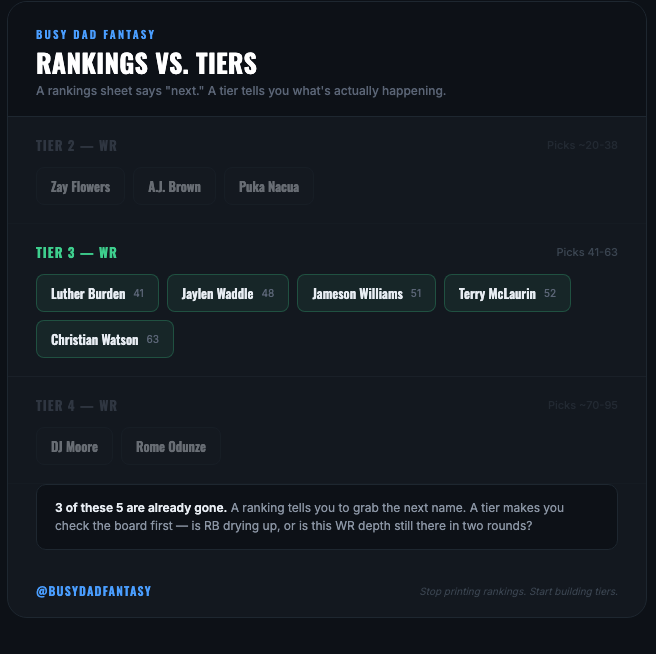
Let's use a real example. Say I have Terry McLaurin, Christian Watson, Jaylen Waddle, Jameson Williams, and Luther Burden all grouped in the same tier. I'm using ADP to build this tier, so I know roughly where each of these guys typically comes off the board.
Now, say I'm on the clock and Burden, McLaurin, and Watson are already gone. I'm left with Waddle and Williams still sitting in my tier. This is exactly the moment tier-based drafting is built for. A rankings-only approach tells me to take whichever one is ranked higher and move on. But I don't just look at the two names left in front of me. I check the other positions first. Are running backs starting to dry up? Is there still a run of decent QB2 options left?
Here's the actual logic behind that check. If running backs are drying up fast, the running backs available right now might not exist in two rounds, while receivers just as good as Waddle or Williams probably will. In that case, the smart move is to grab the back now and trust that my receiver tier, or one close to it, is still there later. If running back is fine and it's actually receiver depth that's about to disappear, then the math flips, and I take Waddle or Williams right now without overthinking which one.
The tier itself never changes. What changes is everything happening around it, and that's what actually decides the pick. A straight ranking can't tell you any of that. It just tells you who's next.
The Bottom Line
That's the whole philosophy behind tier based drafting. It's not about being smarter than a numbered list, it's about admitting a numbered list can't see the things that actually decide draft day. It can't see when a position is drying up. It can't see when the guy ranked 3 spots below your target is really no different from him at all. Only you, sitting there with the board in front of you, can see that.
Now you might be saying you don't have time to build out your own tiers from scratch, and that's completely understandable. Most people don't. The good news is you don't have to build your own to use this approach. Plenty of sites publish free tier based rankings already, and some have paid tiers if you want an even deeper breakdown.
Before your next draft, don't just print out a set of rankings. Find a set of tiers, whether it's yours or someone else's, and know where each one is likely to start thinning out. When you're actually on the clock, you won't be asking who's next on the list. You'll be asking what the board is telling you right now, and that's a much better question to be answering.
Busy Dad Fantasy | X: @BusyDadFantasy
Explore The Lab.